
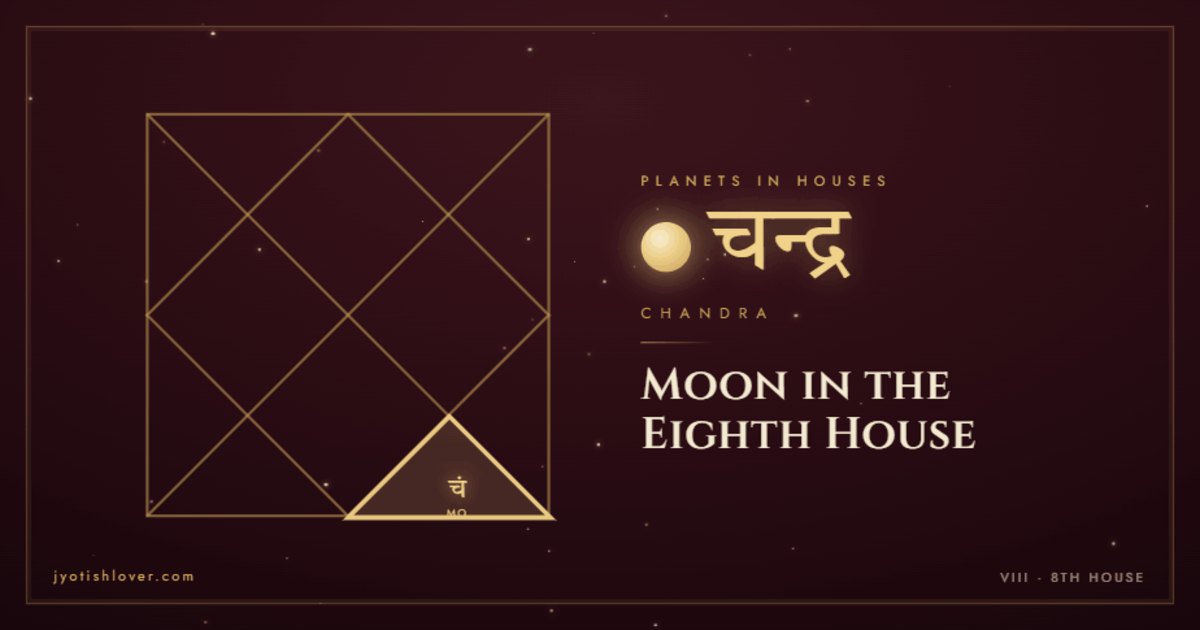
Moon in the 8th House: The Mind That Knows Depth
The 8th house is called Randhra Bhava or Ayu Bhava — the house of longevity, but also of death, transformation, hidden things, and deep mysteries. It rules sudden change, other people’s money (inheritance, insurance, shared resources), and the layers of life that don’t sit on the surface.
The Moon (Chandra) rules the mind and emotions. When she sits in the 8th house, the emotional life turns deep, intense, and tuned to the unseen. This placement is often mislabeled as “bad,” but it actually gives a mind capable of understanding life’s hardest truths — the kind of understanding that only comes from going through difficulty and coming out the other side.
A Story: Samudra Manthan — Churning the Ocean Again
We told the story of the Samudra Manthan for the Moon in the 1st house — the gods and demons churning the ocean for Amrita, the nectar of immortality. But one part of that story belongs to the 8th house specifically: before the nectar appeared, poison (Halahala) rose first.
Shiva drank that poison to save the universe, holding it in his throat — which is why he is called Neelkantha, the blue-throated one. He didn’t run from the poison; he faced it, transformed it, and held it without being destroyed.
That is the deep lesson of Moon in the 8th house. Before reaching the “nectar” — wisdom, transformation, real peace — this placement often has to face some poison first: difficult emotions, losses, hard experiences. But like Shiva, it has the power to transform pain into wisdom instead of being consumed by it.
What This Placement Means
People with Moon in the 8th house often show:
- Deep, intense emotions that don’t stay on the surface — feelings run far below what others see.
- Strong intuition, sometimes bordering on psychic sensitivity — sensing what’s unspoken before it’s said.
- A pull toward mystery — death, psychology, the occult, healing, anything “behind the curtain.”
- Emotional highs and lows that, over time, build real inner strength and wisdom.
- A private inner world — they rarely show their true feelings to everyone; only a few people ever see what’s underneath.
What the Classical Texts Say
Brihat Parashara Hora Shastra (Maharishi Parashara) classifies the 8th house as both a dusthana (a house of difficulty) and a moksha-sthana (a house connected to liberation) — it governs āyus (longevity), mrityu (death-related matters), and hidden knowledge. Applied to a planet as changeable as the Moon, BPHS’s general principle holds with extra force here: her results swing with her strength. A waning or afflicted Moon in a difficult house brings real emotional strain, while a waxing, well-aspected Moon softens even a hard placement. The text’s Chandra Yoga Adhyaya (Chapter 37) also notes a more encouraging configuration worth knowing here: Adhi Yoga, formed when benefic planets occupy the 6th, 7th, and 8th houses counted from the Moon — a reminder that a Moon connected to the 8th house is not automatically unsupported; benefic placement around her can still produce real strength and protection.
Phaladeepika by Mantreswara is unusually direct on this exact placement. In its eighth chapter — the one devoted to how each planet behaves house by house — sloka 7 states plainly that a native born with the Moon in the 8th house will tend toward poor health and a shortened span of vitality unless other factors in the chart offer support. This is one of the more sobering classical verses on the placement, and it’s exactly why Vedic astrologers never read a single placement in isolation: the same text elsewhere teaches that a strong, benefic-aspected 8th house and lord can soften or even reverse this default reading. Phaladeepika’s opening chapter (sloka 14) also lists the traditional names for the 8th house itself — among them Ayus (longevity), Klesa (sorrow), Marana (death), and Vighna (obstacle) — words that capture exactly why this house carries such weight in any reading involving the Moon.
Saravali by Kalyana Varma treats the 8th house as the seat of hidden strengths as much as hidden dangers, noting that a well-supported 8th house makes a person resilient and unusually insightful into things others miss, while an afflicted one can bring early difficulty or hidden troubles. Saravali’s broader teaching on the Moon — that a waxing Moon behaves as a benefic and a waning one needs benefic aspect to soften her nature — applies directly: a Shukla Paksha (waxing) Moon in the 8th tends to channel its intensity into genuine insight, while a Krishna Paksha (waning) Moon here needs more deliberate support, through benefic aspect or a strong dispositor, to do the same.
Jataka Parijata by Vaidyanatha Dikshita adds that a well-placed 8th lord brings long life, sudden gains, and real spiritual insight, while affliction here can show up as chronic health concerns or psychological strain — and notably, the text associates benefics in the 8th house with protection, wisdom, and financial stability rather than only danger. Several later interpretive traditions built on Jataka Parijata’s framework specifically credit Moon in the 8th with strong intuition and a natural pull toward hidden knowledge, occult study, or psychology.
Brihat Jataka by Varahamihira — among the oldest surviving authorities on house-by-house results — treats the 8th house as central to longevity and hidden power, noting that a well-supported 8th house allows a person to survive hardship and even develop unusual inner gifts through it, while a poorly supported one brings sudden loss or a persistent undercurrent of fear. This mirrors the Moon’s own story in this house: difficulty first, depth and strength afterward.
Uttara Kalamrita by Kalidasa, the major karaka (significator) text, is where the deeper logic becomes clear: since the Moon is karaka for the mann (mind), her placement in the house of transformation means the native’s mental and emotional world is naturally drawn toward processing endings, change, and what lies beneath the surface — which is why so many astrologers who use this text’s framework explain Moon-in-8th natives as having an unusually direct relationship with psychological and emotional truth, for better and for harder.
(As always: every one of these classical principles is read together with the ascendant, the Moon’s sign and Paksha, her dispositor, and the aspects she receives — no single text or sloka stands alone in a real reading.)
The Bhagavad Gita: The Soul Never Dies
One of the Gita’s central teachings, in Chapter 2, is that the soul is never born and never dies — untouched by weapons, fire, water, or wind, because it is eternal. The 8th house is tied to death and endings, but the Gita offers a deeper frame: what we call “endings” are changes of form, not the end of the true Self. For Moon in the 8th house, this is real comfort. The losses, changes, and “small deaths” — of relationships, situations, even old versions of ourselves — that this placement tends to live through are not final. They’re part of a larger process, and the Self underneath stays untouched.
The Upanishads: Beyond Death
The Katha Upanishad — the same text that gives us the chariot metaphor — is framed as a conversation between a boy named Nachiketa and Yama, the god of death. Nachiketa asks Yama directly what happens after death, and Yama, moved by the boy’s sincerity, teaches him about the eternal Self that exists beyond the body.
It’s a fitting image for Moon in the 8th house: rather than fearing the “Yama” subjects in life — endings, mystery, the unknown — this placement has real potential to sit with the big questions calmly, the way Nachiketa did, and come away with genuine wisdom. Many people with this placement become natural support for others going through hard times, simply because they aren’t afraid to sit with difficult emotion.
Effects by Sign Placement
- Moon in Cancer (own sign): Deep emotional intuition and strong psychological insight; often naturally gifted at sensing others’ hidden feelings.
- Moon in Taurus (exalted): Softens the 8th house’s intensity — emotional resilience, possible gains through partnership or inheritance, a calmer approach to deep matters.
- Moon in Scorpio (Scorpio’s own sign, but the Moon’s debilitation): A very intense emotional life; real transformation experiences are likely, building strong inner resilience over time.
- Moon in Pisces: Highly intuitive and compassionate, often drawn to spiritual or healing work; needs to protect emotional boundaries.
- Moon in Capricorn: A more practical, grounded approach to deep matters; often handles others’ resources (insurance, inheritance, shared finances) responsibly.
Health Notes
The 8th house relates to chronic or hidden health issues; regular check-ups matter for this placement even when feeling fine. Emotional health and physical health are closely tied here — unresolved feelings can show up as physical tension or illness. Practices that “release” stored emotion — talking to someone trusted, journaling, gentle movement like yoga — help especially.
Money and Shared Resources
This placement often connects to other people’s money: inheritance, a partner’s income, insurance, loans, or investments. Sudden financial swings — both gains and losses — are possible, and an emergency fund brings real emotional security here specifically. Trust and transparency in financial matters with partners or family matter more than usual.
A Simple Remedy
- Don’t bottle up deep emotion — find a trusted friend, family member, or counselor to talk to when things feel heavy.
- Practice grounding activities — time in nature, gentle exercise, or breathing work — to balance the placement’s natural intensity.
- Continue traditional Moon remedies — offering water at night, drinking from a silver glass, and chanting “Om Som Somaya Namaha” on Mondays — for extra emotional steadiness.
- Studying psychology, meditation, healing, or spirituality, formally or simply through reading, often gives this placement’s natural curiosity a real sense of purpose.
Final Words
Moon in the 8th house is not a placement to fear — it’s a placement of depth. The classical texts are honest about its difficulty: Phaladeepika’s own sloka warns of health strain, and BPHS and Brihat Jataka both name the 8th a dusthana. But every one of those same texts also describes the other side — Adhi Yoga from benefics around the Moon, resilience from a strong 8th house in Saravali, wisdom and protection from a well-placed 8th lord in Jataka Parijata. Like Shiva holding the poison in his throat, or Nachiketa sitting calmly with Yama to learn life’s biggest secrets, this placement has the quiet strength to face what others look away from — and come out the other side with real wisdom. The lesson is simple: don’t run from your deep feelings. Sit with them, learn from them, and let them transform you.
Next in our Moon series: Moon in the 9th house — dharma, fortune, and wisdom from teachers and travels.
— JyotishLover.com
