
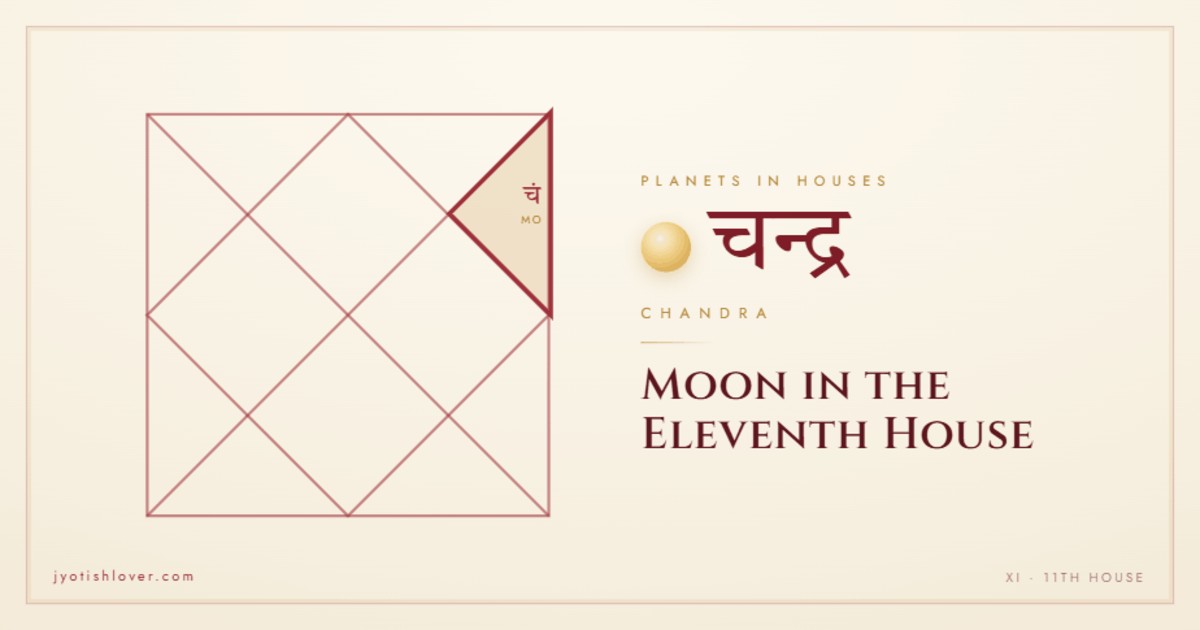
Moon in the 11th House: The Heart That Grows Through People
The 11th house is called Labha Bhava — the house of gains, income, elder siblings, friendships, social groups, and our hopes and desires for the future. It is also an Upachaya house — meaning things connected to it tend to grow and improve over time, especially in the second half of life. In classical texts, it carries names like Labha (gain), Aya (income), Siddhi (accomplishment), and Vibhava (wealth and riches) — a cluster that tells us immediately this is one of the most materially favorable houses in the chart.
The Moon (Chandra) brings emotion, care, and the need for connection. When she sits in the 11th house, friendships and social circles become emotionally essential — this person often feels genuinely fulfilled through their community, friend groups, and the sense of working toward something larger with others.
A Story: Krishna and Sudama — Friendship Beyond Riches
There is a deeply moving story of Krishna and Sudama, two childhood friends. Sudama grew up in poverty while Krishna became a king. When Sudama finally visited, hesitant and embarrassed, bringing only a small handful of beaten rice — all he could afford — Krishna welcomed him with open arms, exactly as a beloved friend, no difference made for the distance of years or the gap in fortune.
That story is the heart of Moon in the 11th house. For this placement, friendships are not about what someone can offer — they’re about real emotional connection, the kind that doesn’t shift even when circumstances change. People with this placement often carry lifelong friendships, sometimes from childhood, that remain emotionally significant across a whole life.
What This Placement Means
People with Moon in the 11th house often show:
- A wide, warm social circle. They tend to feel emotionally at home in groups, communities, and collective spaces.
- Fulfillment through shared goals. Being part of a team working toward something meaningful brings real happiness — more, often, than individual achievement alone.
- Financial gains that come in waves. Income may not always be perfectly steady, but the Upachaya nature of the 11th house means gains tend to accumulate and grow over time. Multiple sources of income are common.
- Dreams that include others. Their deepest wishes rarely stop at themselves — they naturally extend to family, friends, and community.
- A caring, supportive role within their circle. They are often the friend others turn to when life gets hard.
What the Classical Texts Say
Phaladeepika by Mantreswara first names the 11th house and its significations in Chapter 1: the terms include Labha (gain), Aya (income), Agamana (acquisition), Apthi (getting and profit), Siddhi (accomplishment and fulfilment), and Vibhava (wealth and riches) — names that show exactly why every classical astrologer treats this house favorably. Then, in its landmark house-by-house chapter (Chapter 8, Sloka 7), Mantreswara states the Moon’s result here with unusual directness: “Should the Moon occupy the 11th house at birth, the person concerned will be high-minded, long-lived, and wealthy, and will be blessed with children. He will also have comforts of servants.” This is one of the most clearly positive planetary placements in the entire chapter — the Moon in the 11th earns consistent praise from Mantreswara.
Saravali by Kalyana Varma is equally enthusiastic. Its dedicated Moon-in-11th verse reads: “Should the Moon occupy the 11th, the native will be wealthy, will have many sons, be long-lived, will have attendants to serve, be intelligent, sharp, valorous, and splendorous.” Both Phaladeepika and Saravali agree in strong, positive terms — wealth, longevity, and high-mindedness — making Moon in the 11th one of the most consistently well-regarded lunar placements across the classical literature. Saravali’s Chapter 34 also specifies that a strong 11th house, with benefics connected to it, ensures the native achieves their most cherished goals and gains come from multiple directions.
Brihat Parashara Hora Shastra (Maharishi Parashara) classifies the 11th house as an Upachaya (growing house) alongside the 3rd, 6th, and 10th. Upachaya houses have a distinctive quality in Parashari thought: matters connected to them — income, gains, social circles — tend to grow and improve over time rather than being fixed, which makes the Moon’s naturally fluctuating, waxing-and-waning quality a strength rather than a problem here. A planet in an Upachaya house uses the passage of time in its favor, and the Moon in the 11th is no exception.
Brihat Jataka by Varahamihira treats the 11th house (Aaya — the house of gains) as the seat of income, friends, and the fulfillment of aspirations, with Jupiter as the karaka for how well desires are fulfilled through this house. Varahamihira also notes, in his chapter on Raja Yoga combinations, that the Moon alongside Venus and Mercury in the 11th house from Cancer lagna produces a native “joined to power” — one of several combinations that underscore how strongly classical tradition views the 11th house as territory where benefic planets, including the Moon, perform well.
Jataka Parijata by Vaidyanatha Dikshita builds on the broader Parashari framework in its treatment of gains and social achievement: when the 11th lord and its occupants are strong, the native fulfills aspirations and gains through both personal effort and social connections. The Moon’s significations — the masses, the public, emotional bonds — make her a natural fit for this house’s themes of community, networking, and the kind of gains that come through people rather than alone.
Uttara Kalamrita by Kalidasa includes gains, income, elder siblings, left ear, the satisfaction of desires, and recovery from illness among the 11th house’s significations — a comprehensive list that expands the house beyond just money to include the broader idea of wishes being granted. Since the Moon is karaka for the mann (mind) and emotional desires, her placement in the house of desire-fulfillment means this native’s emotional wishes have unusual fertile ground — when the Moon is strong and well-supported, what they emotionally long for tends to materialize over time.
Sarvartha Chintamani by Venkatesa Sarma notes that the 11th house as an Upachaya supports sustained accumulation rather than single dramatic windfalls — consistent with the Moon’s natural rhythm of waxing and waning rather than sudden peaks. This text also reinforces the principle across Upachaya houses that even naturally challenging planets improve over time when placed here — which for the well-supported Moon means gains that deepen and stabilize across a lifetime rather than burning brightly and fading.
(As always: every classical result here is conditional on the Moon’s Paksha strength, the dispositor’s condition, and the aspects she receives in any individual chart.)
The Bhagavad Gita: We Are All Connected
In Chapter 5, Krishna teaches that the wise see the same essential Self in every being — scholar and servant, learned and simple alike. The 11th house is about our place in the larger community, and the Moon here brings emotional warmth to that connection. Just as Krishna received Sudama with unchanged love regardless of his poverty, this Gita teaching is a gentle reminder: real friendship and community come from recognizing the same spirit in everyone — not from what someone has, what they can give, or what social position they occupy. When this placement’s natural warmth extends equally to everyone rather than only to those who seem “useful,” it produces the deepest form of the social happiness this house promises.
The Vedas: “May All Be Happy” — The Spirit of Shared Wellbeing
Sarve bhavantu sukhinah, sarve santu niramayah — “May all beings be happy, may all beings be free from illness.” This prayer from the Vedic tradition is not a private wish. It asks for the wellbeing of everyone, seen and unseen, known and unknown.
That spirit fits Moon in the 11th house perfectly. This placement’s deepest wishes are rarely purely personal — they tend to extend naturally to the wellbeing of friends, community, and even strangers. When this person works toward goals that benefit a group rather than only themselves, they often discover their greatest sense of purpose and emotional satisfaction.
Effects by Sign Placement
- Moon in Cancer (own sign): Deep, caring friendships; may serve as an emotional anchor for the friend group; gains often connected to nurturing or community-based work.
- Moon in Taurus (exalted): Steady, cumulative financial gains; loyal long-term friendships; generally favorable for both income and social connections.
- Moon in Scorpio (debilitated): Friendships may go through more intense phases — some come and go — but those that remain tend to be powerfully loyal and emotionally significant.
- Moon in Aquarius: Drawn to large communities, humanitarian causes, and groups working toward collective goals; values friendship built on shared ideals rather than convenience.
- Moon in Leo: Warm and generous within their social circle; may take on a natural leadership or host role among friends; enjoys bringing people together.
Money and Gains
Income often arrives through multiple channels or in waves rather than a single steady stream — building savings during abundant periods creates emotional security during quieter ones. Financial gains frequently come through networking, friendships, and group efforts: collaboration tends to produce more than working entirely alone. Generosity comes naturally to this placement — sharing gains with friends and family, as Krishna shared with Sudama, tends to invite even more in return over time.
Career Notes
This placement supports careers in:
- Community organizing, networking-based roles, social work, and advocacy.
- Group-based businesses — cooperatives, partnerships, team-driven projects.
- Fields connected to technology, social platforms, or large communities.
- Any work where building and maintaining relationships is central to success.
Health Notes
The 11th house relates to the legs and ankles (along with the shins); staying socially active also tends to support overall wellbeing for this placement, since isolation can affect mood more sharply here than for many others. Emotional health benefits greatly from regular, genuine contact with friends — even something as simple as a phone call or a cup of tea together makes a real difference. Long-term health habits, built steadily over time, tend to pay off especially well given the Upachaya nature of this house.
A Simple Remedy
- Reach out to old friends and long-standing connections — this placement carries a particular emotional significance for friendships that have lasted across time.
- Practice generosity without conditions — give freely to friends and community when you’re able; the spirit of Krishna welcoming Sudama is a real, working principle here.
- Continue traditional Moon remedies — offering water at night, drinking from a silver glass, and chanting “Om Som Somaya Namaha” on Mondays.
- Join or contribute actively to a community group, cause, or club that aligns with your values — this kind of belonging brings some of the deepest emotional fulfillment this placement is capable of.
Final Words
Moon in the 11th house is a placement of the heart connected to others — like Krishna’s unchanging welcome to his old friend Sudama, no difference made for the years or the distance of fortune in between. The classical texts are unusually consistent here: Phaladeepika calls this person high-minded, long-lived, and wealthy; Saravali calls them intelligent, valorous, and splendorous; BPHS names the 11th an Upachaya house where gains grow over time; and Brihat Jataka places benefic planets here as a source of high achievement and fulfilled aspirations. The Gita and the ancient Vedic prayer speak the deeper truth beneath all of that: the greatest gains are the ones we build and share together with the people — and the communities — that we genuinely care about.
Next in our Moon series: Moon in the 12th house — solitude, spirituality, and letting go.
— JyotishLover.com
