
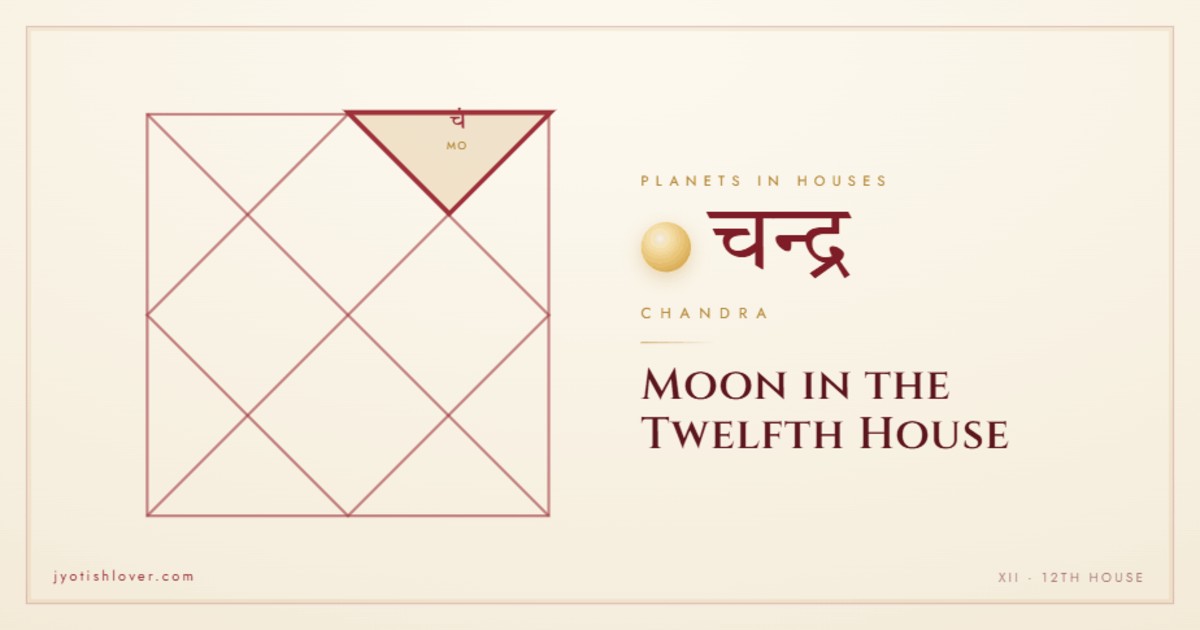
The 12th house is called Vyaya Bhava — the house of loss, expenditure, solitude, faraway lands, sleep, hidden enemies, hospitals, monasteries, and ultimately, moksha (liberation). In Phaladeepika’s list of names for this house: Duhkha (misery), Kshaya (loss and decline), Daridrya (poverty), Vyaya (expenditure), and Bandha (confinement) — words that make it one of the three classical Dusthanas (difficult houses), alongside the 6th and 8th.
And yet — the 12th house is also one of the three Moksha Trikonas (liberation houses), alongside the 4th and 8th. It is the house where the soul prepares to dissolve, to let go, to transcend. When the Moon (Chandra) — planet of mind, emotion, and the felt sense of self — sits here, she walks a delicate path: outwardly, things connected to her may be tested; inwardly, she has the potential for one of the deepest spiritual gifts the chart can offer.
This is a placement that the classical texts describe honestly — and honestly means acknowledging both the difficulty and the hidden depth.
A Story: Meera Bai — Love That Dissolves the Self
Meera Bai, the 16th-century saint-poet of Rajasthan, gave up everything that the world values — her royal position, her social standing, her security — for one consuming devotion to Krishna. She wandered, she sang, she was ridiculed, she was separated from home and palace. By every worldly measure, her life involved real loss. Yet she is remembered not for what she lost, but for what she became — a voice of devotion so pure it still moves people five centuries later.
Her life is one of the great images of the Moon in the 12th house. The outer world may not always recognize or reward this placement’s inner gifts. The loss is real. But what grows in that quiet, in that surrender, in that letting go — can be something the outer world cannot measure at all.
What This Placement Means
People with Moon in the 12th house often experience:
- A strong inner life and vivid dream world. The subconscious is active and imaginative — this placement often produces rich dreamers, intuitive people, and those with unusually developed inner awareness.
- A pull toward solitude. Quiet, retreat, and time alone genuinely restore this person in a way that social contact does not always do. Isolation can sometimes feel more natural than belonging.
- Emotional sensitivity that is felt but not always shown. Feelings run deep and often stay private — this person may seem composed while carrying a rich inner world that few people ever see fully.
- A spiritual or contemplative orientation. Even without formal religious practice, this placement tends toward inner searching, questions of meaning, and an instinctive connection to what lies beneath the surface of things.
- Expenditure and material loss over time. The 12th house’s nature as Vyaya Bhava means financial carefulness is important — money can slip away easily, sometimes through generous impulses, sometimes through circumstances beyond control.
- Connections to foreign lands or faraway places. Travel, living abroad, or working in institutions (hospitals, ashrams, prisons, large organizations) often features in the life story.
What the Classical Texts Say
Phaladeepika by Mantreswara is direct. Its opening chapter (sloka 16) names the 12th house using terms such as Duhkha (misery), Kshaya (loss), Daridrya (poverty), and Vyaya (expenditure) — thereby establishing it clearly as a Dusthana. Then, in its house-by-house chapter on planetary results (Chapter 8, sloka 7), Mantreswara states the Moon’s result plainly: “When the Moon is placed in the 12th house, the native is indolent, humiliated, and unhappy. Others have animosity against him.” This is among the more sobering readings in the chapter, and it reflects the core classical concern: the Moon, planet of mind and emotion, placed in the house of loss, can make the inner world feel persistently heavy. Mantreswara also notes, consistent with the general rule, that the Moon’s condition — Paksha, dispositor, and aspects received — significantly modifies these results in either direction.
Saravali by Kalyana Varma gives a similarly candid reading: the Moon in the 12th makes the native odious, fallen in moral sense, mean, suffering from eye disease, indolent, distressed, and insulted. Both Saravali and Phaladeepika frame the worst reading as the default — but both texts also operate on the well-understood classical principle that a Moon aspected by benefics, or well-placed in her own sign Cancer in the 12th, significantly reverses or softens this reading. Saravali’s Cancer Moon in the 12th, for instance, is recognized by practitioners as a more spiritually inclined, less materially challenged version of this placement.
Brihat Jataka by Varahamihira describes the 12th-house Moon as producing one who is “wickedly disposed and defective in some limb” — a stern classical reading that, once again, reflects the default condition of a weakened Moon in a Dusthana. Varahamihira’s broader teaching is that all results depend on planetary dignity and aspect, which means these readings are the lower bound, not the fixed destiny.
Bhrigu Sutras offer perhaps the most nuanced classical reading on this placement: “If the Moon in the 12th house is associated with a benefic, the native will be learned, kind-hearted, will have good friends, and will go to heaven after death.” And: “If the Moon is associated with a malefic, the native will go to hell.” These two verses together give the classical frame in its full form — the 12th house Moon is not fixed in either direction; it moves dramatically with what aspects and influences the Moon receives. A well-supported Moon in the 12th is not the same placement at all as an afflicted one.
Chamatkar Chintamani adds an important softening: while acknowledging difficulty, it notes that the Moon in the 12th often brings expenditure on good causes — genuine charitable generosity is a real signature of this placement at its best, alongside its challenges.
Brihat Parashara Hora Shastra (Maharishi Parashara) classifies the 12th house as Vyaya Bhava — the house of expenditure, foreign residence, spirituality, and losses — but also as part of the Moksha Trikona (4th, 8th, and 12th houses), which together govern the soul’s journey toward liberation. BPHS states that when the 12th house is connected with benefics, expenditure goes toward good causes, and liberation becomes a real theme of life. The Moon here, in her capacity as mann karaka (mind significator), can give a mind that is drawn inward, toward the transcendent, rather than outward toward worldly gain — a real spiritual gift, even when it makes ordinary life harder.
Uttara Kalamrita by Kalidasa lists the 12th house’s significations as including seclusion, detachment, hospitals and asylums, the unconscious mind, past-life karma, and — importantly — moksha itself. Since the Moon governs the mann (mind), her placement in the house of the unconscious in Kalidasa’s framework means this native’s inner mental life is closely connected to deep, often non-rational emotional currents — past-life impressions, karmic residue, dreams, and spiritual longing — all of which can feel overwhelming without the right spiritual practice, but can become the deepest source of wisdom once channeled well.
Jataka Parijata by Vaidyanatha Dikshita situates the 12th house within the broader framework of how a planet’s house placement shapes the available karma: the 12th is 12th from the 1st (loss of self-identification), and its connection to moksha makes it the house where ordinary ego-based desires begin to thin out — a challenging process, but ultimately the soul’s direction. A Moon here, in Vaidyanatha’s framework, is working through the surrender of emotional attachment as a karmic theme.
(The classical results here depend heavily on the Moon’s Paksha, sign, dispositor, and the benefic or malefic aspects she receives — more so for the 12th house than almost any other. Always read these principles in context.)
The Bhagavad Gita: Surrender as Strength
In Chapter 18, Krishna gives the Gita’s final and deepest instruction: “Abandon all varieties of dharma and simply surrender unto Me alone. I shall deliver you from all sinful reaction. Do not fear.” (18.66, paraphrased)
The word used is sharanagati — complete surrender, the giving up of the personal will into something larger. This teaching speaks directly to Moon in the 12th house. This placement’s deepest spiritual invitation is exactly this: the gradual release of the need to control the emotional experience, the need for recognition, the need for outcomes — and the discovery that, in that release, something much quieter and more real becomes available. This doesn’t mean passive resignation; it means a different kind of strength, the strength of not needing things to be other than they are.
The Upanishads: The Ocean and the Wave
The Mandukya Upanishad teaches that the individual self (jiva) is not separate from the universal Self (Brahman) — the appearance of separation is the play of maya, and moksha is the recognition of what was always true. A wave rises, moves, and dissolves back into the ocean. It was never separate from the ocean. What seemed like loss was only the form changing, not the reality.
For Moon in the 12th house, this image is both a comfort and a practice. The losses this placement tends to experience — of emotional security, of recognition, of belonging — are the wave dissolving. The invitation is to see the ocean underneath, which was never lost at all.
Effects by Sign Placement
- Moon in Cancer (own sign): Significantly softens the 12th house’s difficulty. Deep compassion, strong spiritual intuition, possible connection to charitable or healing work. One of the better versions of this placement.
- Moon in Taurus (exalted): Brings a more stable, grounded 12th house experience — less financial instability, more capacity for genuine spiritual practice. Foreign lands or distant places may become a source of comfort rather than hardship.
- Moon in Scorpio (debilitated): The most intense version of an already intense placement — emotional undercurrents run very deep, possible feelings of emotional isolation or unseen enemies; but also the deepest potential for transformative spiritual experience.
- Moon in Pisces: A naturally harmonious match for the 12th house’s spiritual and dissolving quality; highly intuitive, compassionate, and often drawn to retreat, meditation, or service to those who are suffering.
- Moon in Virgo: More practical about the 12th house’s themes; may express this placement through work in healing, service institutions, or behind-the-scenes analytical roles.
Foreign Lands, Institutions, and Hidden Work
A consistent classical and practical observation: Moon in the 12th often connects the native to faraway places, foreign countries, or foreign-born people in emotionally significant ways — sometimes the greatest sense of emotional comfort is found away from the birthplace. Work in hospitals, ashrams, large institutions, research settings, spiritual organizations, or any role carried out in private or semi-private settings often suits this placement far better than highly public roles.
Health Notes
The 12th house relates to the feet and the left eye in the classical body mapping. Eye care, adequate sleep, and sufficient physical rest are important — this placement often runs on inner rather than outer energy and can exhaust itself when pushed toward extroversion. Sleep quality tends to be emotionally significant; this person benefits from good sleep hygiene and a calm, quiet environment. Mental health attention — meditation, therapy, spiritual practice, time in nature or near water — is especially valuable rather than optional.
Money and Expenditure
Vyaya Bhava’s most direct worldly effect is spending, and the Moon’s presence here can make expenditure emotionally driven — spending to soothe feelings, spending on others generously, spending on beauty or comfort. Building a deliberate savings habit, treating financial reserves as emotional security rather than just practicality, provides real stability for this placement.
A Simple Remedy
- Make time for genuine solitude and inner quiet regularly — not as a last resort when exhausted, but as a built-in part of life. This placement genuinely needs it.
- Practice some form of surrender in daily life — meditation, prayer, journaling, or any spiritual practice that involves releasing, rather than grasping.
- Continue traditional Moon remedies — offering water at night, drinking from a silver glass, and chanting “Om Som Somaya Namaha” on Mondays. For Moon in the 12th specifically, doing these practices near water (a river, the sea, or even a bowl of water placed with intention) carries extra resonance.
- Charity and quiet service — giving without seeking recognition — fulfills one of this placement’s deepest emotional callings and tends to shift its energy from loss toward liberation.
Final Words
Moon in the 12th house is, by classical measure, one of the more challenging placements for the Moon. Phaladeepika and Saravali are honest about that. But they are also consistent with the classical principle that the Moon’s condition — her Paksha, her aspects, her sign — makes an enormous difference, and that a Moon touched by benefics in the 12th house is a very different experience from an afflicted one. The Gita’s teaching on surrender and the Upanishadic image of the wave returning to the ocean speak to the deeper truth: what looks like loss from the outside is often, from the inside, the beginning of letting go. And the soul that has learned to let go of what it cannot hold — recognition, permanence, emotional security on the world’s terms — often finds something the world could never have given it anyway.
This concludes our Moon through the 12 houses series. May the light of Chandra illuminate your path through each of her twelve homes.
